
Does your lower back feel stiff after a long day at your desk? For many office workers, sitting for hours can leave the lower back feeling tired, tight, or uncomfortable. The problem is often not sitting itself, but how you sit and whether your chair provides enough lumbar support.
A back care cushion can help fill the gap between your lower back and chair, encouraging a more supported sitting position. However, a cushion works best when combined with good desk ergonomics, regular movement, and a properly adjusted chair.
What Studies Say About Back Pain Among Pakistani Office Workers
Research shows that back and musculoskeletal problems are common among office workers in Pakistan:
- Lahore: A study of 669 office workers found that 29.45% reported low back pain (PAFMJ)
- King Edward Medical University, Lahore: Research involving 300 office workers found a 29.2% point prevalence and 69.2% lifetime prevalence of low back pain (Research Gate)
- Peshawar: A study of 200 office workers found that 64% reported lower-back discomfort, while 88% reported musculoskeletal discomfort overall. Participants sat for an average of about 6.1 hours per day (AAHS).
These figures highlight why proper sitting posture, regular movement, and adequate lumbar support are important for people who spend long hours at a desk.
What is a Back Care Cushion?
A back care cushion is a supportive cushion designed to provide additional support to the lower back while sitting. Most are shaped to follow the natural inward curve of the lumbar area.
Unlike a flat cushion, a contoured design back support cushion can provide support where the lower back needs it most. This can be particularly useful if your office chair has a flat backrest or does not provide enough lumbar support.
The goal is simple: help you maintain a more natural sitting position instead of constantly slouching toward your desk.
Why Long Office Hours Can Be Hard on Your Back
When you sit for extended periods, your posture can gradually change without you noticing. You may lean forward toward the computer, slide your hips forward, or round your shoulders.
Common habits include:
- Leaning toward the monitor
- Sitting on the edge of the chair
- Rounding the lower back
- Keeping the screen too low
- Remaining in one position for several hours
- Using a chair with little lumbar support
A poorly adjusted workstation can make these habits worse. A supportive cushion cannot correct every ergonomic problem, but it can be a useful part of a better sitting setup.
How Does a Back Support Cushion Help?
A properly designed cushion supports the lumbar area and can make it easier to maintain an upright sitting position.
It may help by:
- Supporting the natural curve of the lower back
The cushion fills the space between your back and the chair. - Reducing the tendency to slouch
Better lumbar support can make an upright position easier to maintain. - Improving sitting awareness
When your lower back has adequate support, you may be less likely to collapse into a rounded posture. - Making long periods of sitting more manageable
This is especially useful for desk-based work, studying, remote work, and driving.
It is important to remember that a cushion is not a treatment for an underlying medical condition. Persistent or severe back pain should be evaluated by a qualified healthcare professional.
What Should You Look for in an Office Back Cushion?
Not every cushion will suit every chair or person. Before choosing one, consider these practical features.
1. A Contoured Shape
Look for a design that follows the natural curve of the lumbar region. A completely flat cushion may not provide the same level of targeted support.
2. Supportive Foam
The foam should provide enough resistance to support your lower back without feeling excessively hard. High-density foam is commonly used in supportive cushions because it can maintain its structure under regular use.
3. A Secure Strap
A cushion that constantly moves out of position can become frustrating. An adjustable strap can help keep it attached to an office chair throughout the workday.
4. Breathable Cover
Pakistan’s warmer climate can make prolonged sitting feel uncomfortable, particularly during summer. A breathable outer cover can help make the cushion more suitable for extended daily use.
5. Appropriate Size
The cushion should provide support without pushing your upper body too far forward. If it is excessively thick for your chair, your sitting position may actually become less natural.
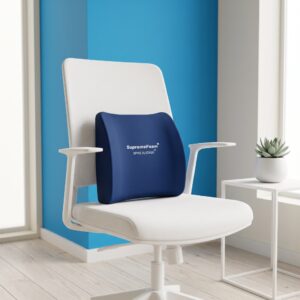
Supreme Spine Aligner for Office Seating
For people looking for additional lumbar support, Diamond Supreme Foam’s Supreme Spine Aligner is designed specifically for this type of use.
The cushion uses contoured high-density foam to support the lower back and includes an adjustable elastic strap that helps secure it to an office chair. It can also be used on car seats, making it practical for people who spend significant time driving.
Its breathable outer cover is another useful feature for people who sit for extended periods, especially in warmer environments.
The key point is not simply adding another cushion to your chair. The aim is to create a more supportive connection between your lower back and the backrest.
How to Set Up Your Cushion Correctly
Even a good lumbar cushion needs to be positioned properly.
Try these steps:
- Sit all the way back in your chair.
- Place the cushion around the natural curve of your lower back.
- Secure the strap so the cushion does not slide.
- Keep both feet supported on the floor or on a footrest.
- Adjust your chair so your knees are around hip level or slightly lower.
- Keep your monitor close to eye level.
- Position your keyboard and mouse so you do not have to reach forward.
- Change position and take short movement breaks throughout the day.
The cushion should support you without forcing your back into an exaggerated position.
Supreme Spine Aligner vs. Regular Chair Cushion
These two products serve different purposes.
| Feature | Supreme Spine Aligner | Regular Seat Cushion |
| Main purpose | Lower-back support | Seat support |
| Position | Against the backrest | Against the backrest |
| Primary focus | Lumbar area | Sitting surface |
| Useful for | Poor lumbar support | Hard or uncomfortable seats |
| Typical design | Contoured | Flat or contoured seat shape |
If your main problem is a lack of lower-back support, a supreme spine aligner is generally more relevant than simply adding padding underneath you.
Simple Habits That Can Improve Office Sitting
A spine aligner back cushion should be part of a bigger approach to workplace ergonomics.
Try to:
- Stand up regularly instead of sitting continuously.
- Walk for a few minutes during longer breaks.
- Avoid working from a sofa for several hours.
- Keep your laptop or monitor at a comfortable viewing height.
- Change your sitting position throughout the day.
- Use a chair that supports your back and allows proper foot placement.
- Avoid ignoring recurring or worsening pain.
These small changes can make your workstation more supportive without requiring major changes to your office.
Conclusion: Better Support Starts With Better Sitting
Long office hours do not automatically mean your back has to feel strained at the end of the day. A properly adjusted chair, good workstation positioning, regular movement, and suitable lumbar support can create a more supportive sitting environment.
For people whose office chair lacks adequate lower-back support, a Supreme Spine Aligner from Diamond Supreme Foam can be a practical addition. The focus should always be on supporting healthy sitting habits rather than relying on a cushion alone.
Also Read: How Coccyx Cushion is a Game Changer For Office Workers
Frequently Asked Questions
1. Is a back care cushion good for office work?
Yes. A properly shaped lumbar cushion like Supreme spine aligner can provide additional lower-back support when an office chair does not adequately support the natural curve of the spine.
2. Where should a spine aligner be placed?
It should sit against the lower back, supporting the natural inward curve just above the pelvis. It should not be positioned too high around the middle or upper back.
3. Can I use the Supreme Spine Aligner on an office chair?
Yes. The Supreme Spine Aligner is designed to attach to office chairs using an adjustable elastic strap. It can also be used on car seats.
4. How long should I sit with a spine aligner back support cushion?
There is no single ideal number of hours. The important point is to avoid staying in one position continuously. Use the cushion as part of an ergonomic setup and take regular movement breaks.
5. Can a spine aligner cure lower back pain?
No. A cushion is intended to provide support, not cure a medical condition. If back pain is persistent, severe, or associated with other concerning symptoms, consult a healthcare professional.